Eight Years Later – Would We Still Build This Porsche?
Back in 2018 I made a film about a rather extraordinary Porsche we'd created, now eight years on....

We currently have two 987 Boxster Spyders at Williams Crawford, and having the two cars here has reminded me just how interesting this little chapter in Porsche history is.
Because this wasn’t simply a Boxster S with a different badge, some bigger wheels and a few more horsepower.
Porsche actually went in the opposite direction.
They took an already very good sports car and started taking things away.
And I think, 15 years later, that philosophy makes more sense than ever.
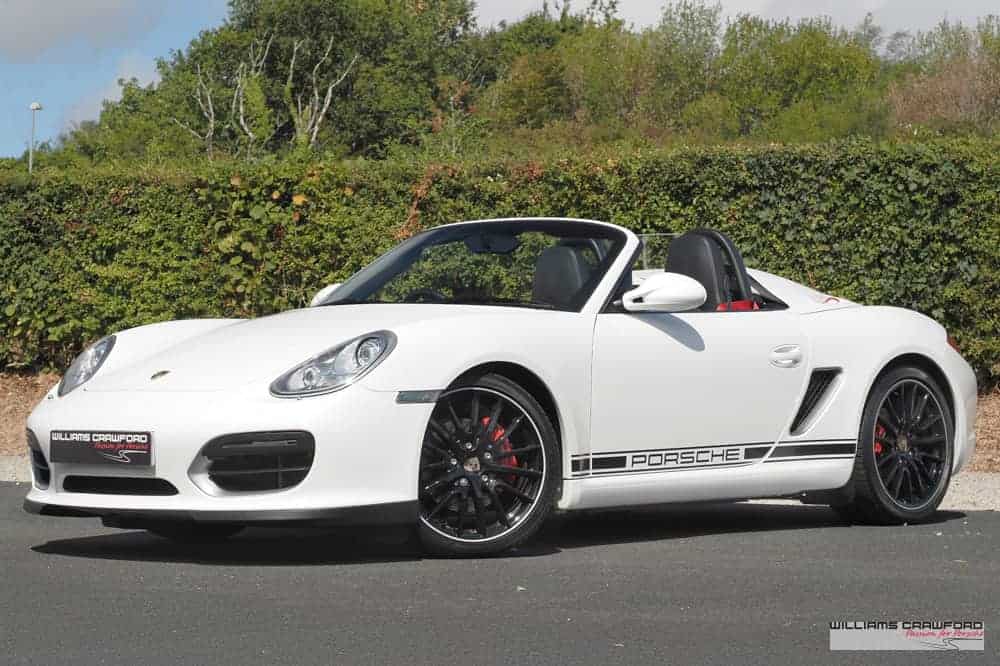
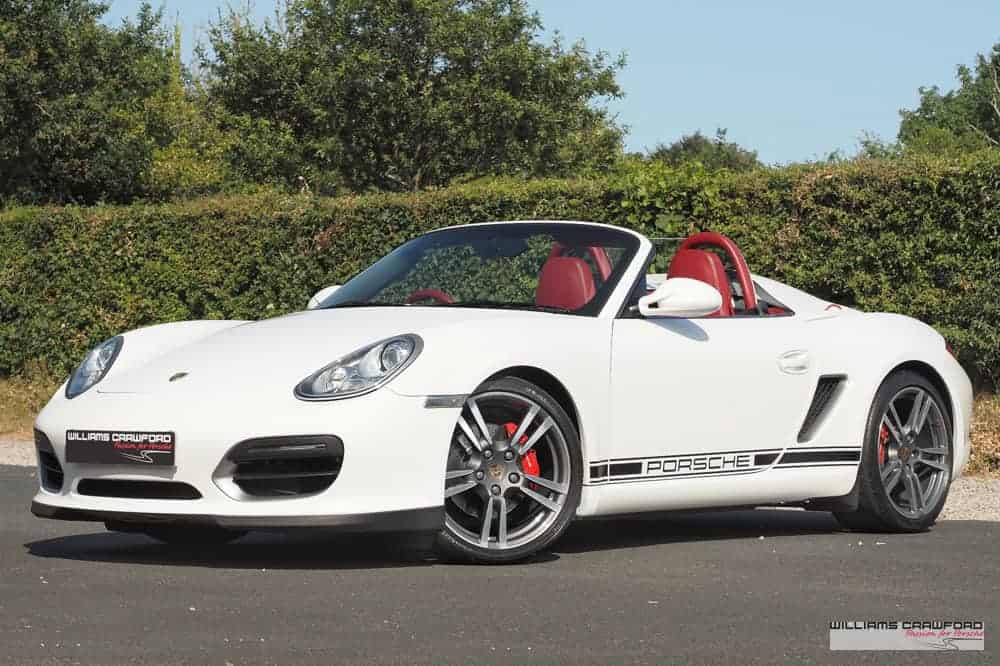
The starting point was the 987 generation Boxster S and its naturally aspirated 3.4-litre flat-six.
The S produced 310 hp. The Spyder got 320 hp, with peak power arriving higher up the rev range at 7,200 rpm.
But another 10 horsepower wasn’t really the story.
Weight was.
Porsche removed around 80 kg compared with the Boxster S, bringing the manual Spyder down to just 1,275 kg and making it the lightest road car Porsche offered at the time.
The electric roof went.
In came that wonderfully eccentric lightweight canvas arrangement weighing less than 6 kg.
The doors were aluminium. So was the unique one-piece rear deck. The side windows were lighter. The special 19-inch wheels each weighed less than 10 kg and were, at the time, the lightest 19-inch wheels Porsche offered.
Inside, lightweight sports bucket seats were part of Porsche’s weight-saving programme. Door handles became fabric pulls.
Air conditioning? Deleted as standard.
Radio? Deleted.
Cup holders and door pockets? Deleted.
Porsche even removed the cowling over the instrument binnacle.
Some of the individual savings were tiny.
But it was the philosophy that mattered.
Porsche said its engineers wanted to improve performance not simply by adding more engine power.
Instead, they looked at the whole car.
The suspension was 20 mm lower than the Boxster S, with shorter and stiffer springs, firmer dampers and larger anti-roll bars.
It had a mechanically locking rear differential as standard.
The track was wider. The centre of gravity was lower. The steering response was changed.
So this wasn’t really a special edition.
It was a properly re-engineered Boxster.
And then there was the shape.
Those two wonderful humps behind the seats weren’t simply styling. Porsche was deliberately connecting the car with its earlier Spyder racing cars. The long rear deck and low roof gave it a shape quite unlike a normal Boxster.
It still looks special today.
The motoring press loved it.
Car and Driver concluded that Porsche had somehow made the Boxster an “even sharper sword.”
Top Gear called it an “exceptionally good car”, particularly praising the way its suspension combined control with compliance on real roads.
Auto Express found it quicker and more agile than the Boxster S and highly recommended it for drivers prepared to accept a few compromises in exchange for greater involvement and exclusivity.
The roof received rather less praise!
But that’s part of the charm.
2The Spyder wasn’t designed around sitting in traffic with every possible luxury switched on. Porsche itself said it had been developed essentially for driving in the open air.
That tells you quite a lot about the car.
Both of our current cars are PDK, and I think that’s worth talking about.
There’s a temptation today to assume that the purist choice must always be manual.
I don’t necessarily agree.
Porsche offered PDK on the Spyder from new for a reason. The seven-speed double-clutch gearbox changes gear extremely quickly without interrupting the flow of power.
With PDK, Sport Chrono and Launch Control, Porsche quoted 0-62 mph in around 4.8 seconds.
For someone who actually wants to use their Spyder rather than preserve it as an object, PDK makes the car wonderfully easy.
Potter through town, go touring, then find a good road and it becomes a completely different machine.
Purity isn’t only about having a clutch pedal.
It’s about how the whole car communicates with you.
And the 987 Spyder has that in abundance.
This is perhaps the bit that surprised me most.
The generally accepted production figure, based on information subsequently obtained from the Porsche Historical Archive, is only 1,944 987 Boxster Spyders worldwide.
And the reported figure for the UK is just 237 cars.
That’s worth putting into perspective.
Approximate UK numbers for some very well-known Porsche driver’s cars are:
And then consider perhaps the most famous RS of them all.
Porsche built 1,580 Carrera RS 2.7s worldwide. Historical records put the number originally supplied to the UK in right-hand drive at only 111.
I’m certainly not suggesting a 987 Spyder is the next 2.7 RS.
It isn’t.
But the comparison gives some perspective to the numbers.
There are approximately as many UK 987 Spyders as there are 996.2 GT3s, fewer than 997.1 GT3s, and considerably fewer than the later 981 Cayman GT4.
That’s quite something for a Porsche which you can still buy for a fraction of the price of many GT and RS cars.
Perhaps that’s what makes the story so interesting.
This wasn’t a numbered £200,000 collector’s edition.
At the time, some people must have looked at the awkward roof, missing equipment and extra price over a Boxster S and wondered why Porsche was asking them to pay more to receive less.
Today, I think we look at it completely differently.
Naturally aspirated engines are disappearing.
Hydraulic steering has disappeared from new Porsche sports cars.
Cars have become larger, heavier and more complicated.
Suddenly, paying Porsche to take things away doesn’t seem quite so strange.
For me, it’s the combination.
It’s small by modern standards.
It’s light.
It’s naturally aspirated.
It’s mid-engined.
4It has hydraulic steering.
It has a proper mechanical limited-slip differential.
It looks noticeably different from a standard Boxster.
And despite all this talk of minimalism, it still has two boots. You can actually go away in it.
Then you put the roof away.
You’ve got that flat-six just behind you, you’re sitting low in the car, the steering is alive in your hands and you’re travelling down an ordinary British road at an ordinary speed.
That’s the important bit.
You don’t need to be doing 150 mph to understand a 987 Spyder.
In fact, I’d argue the opposite.
Much of its pleasure exists at speeds where you can actually enjoy it.
I don’t suggest buying a Porsche simply because you think it will increase in value.
Buy the car you want to drive.
But if I were looking through the Porsche range today for cars which have some of the ingredients collectors tend to appreciate later, the 987 Spyder is difficult to ignore.
Only around 1,944 worldwide and 237 for the UK.
A naturally aspirated flat-six.
A lightweight philosophy.
Special bodywork.
Special chassis.
Hydraulic steering.
A direct link to Porsche’s Spyder history.
And a driving experience sufficiently different from the ordinary Boxster S to justify the badge.
Its sister car, the Cayman R, is already recognised as something special. The 996 and 997 GT cars have moved into a completely different price category. And the 981 GT4, wonderful though it is, arrived in considerably greater UK numbers.
5The 987 Spyder sits in a very interesting place between them.
Sometimes the Porsche world takes a while to recognise what it had.
I suspect the 987 Boxster Spyder may be one of those cars.
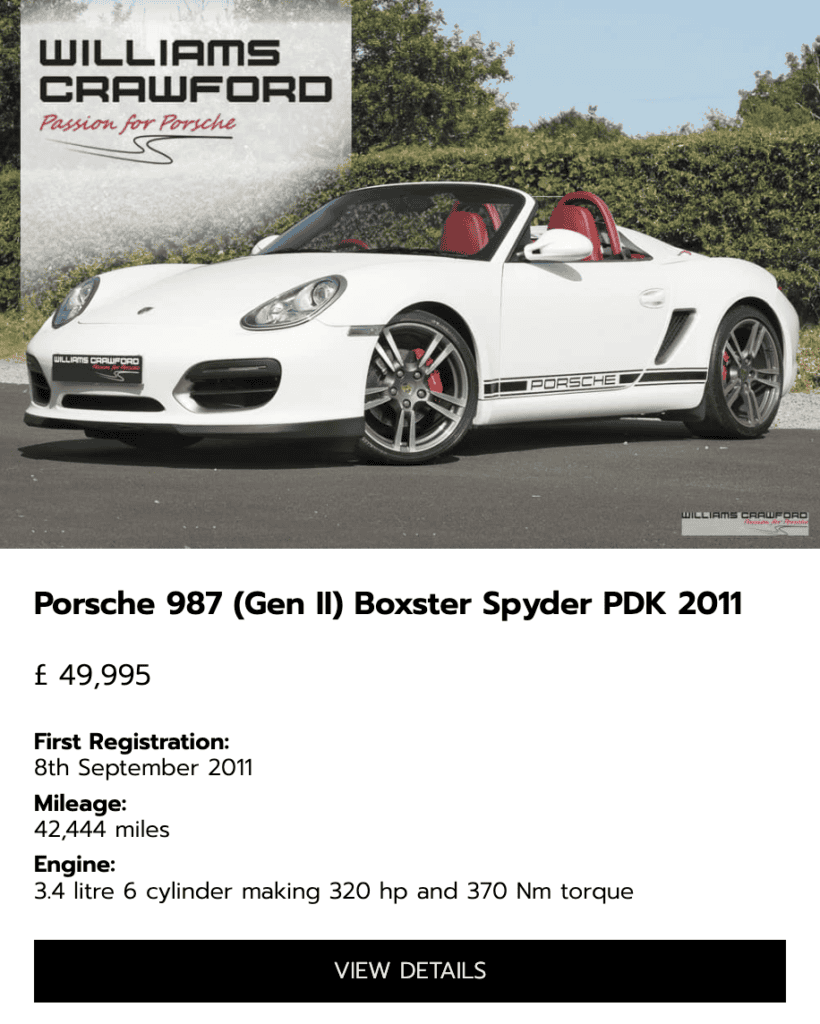
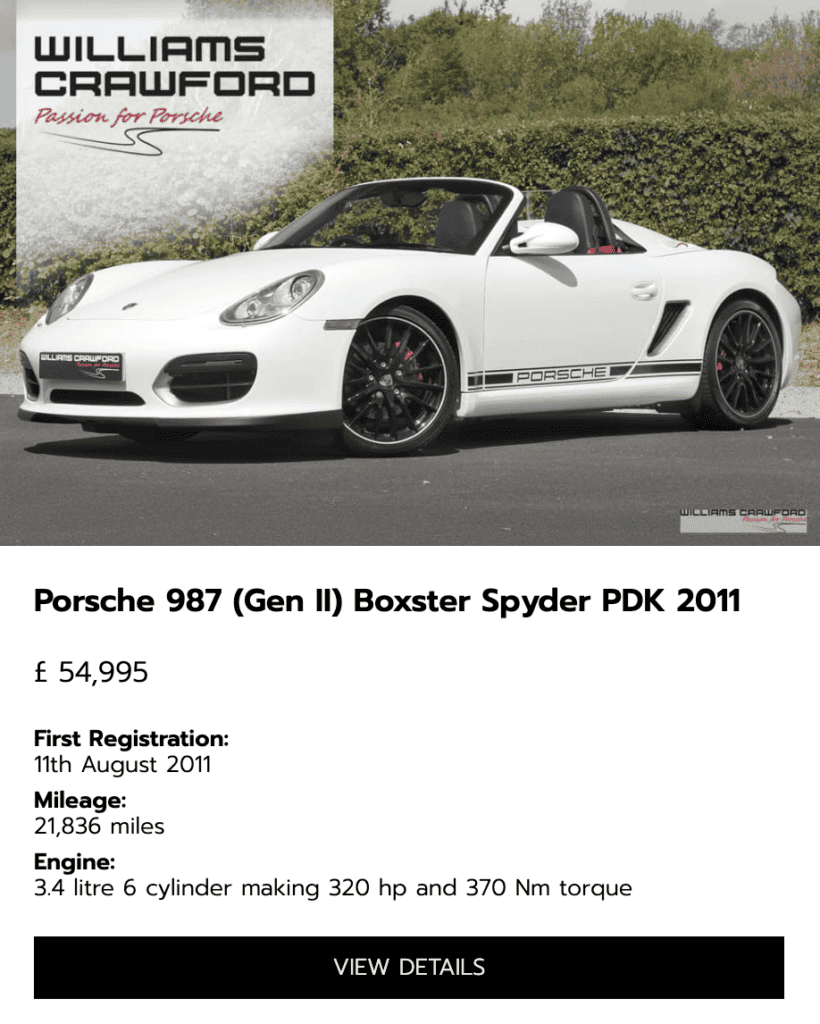
We currently have two PDK examples at Williams Crawford, giving us a fairly unusual opportunity to put two of these 237 UK cars together.
If you’ve never driven one, come and have a look.
The funny little roof, aluminium panels, beautiful rear humps and all the things Porsche deliberately left out start to make rather more sense when you see the complete package.
We look forward to seeing you in the New Year and wish you a happy and prosperous start to the year ahead!
Wednesday 31st December: Closed
Thursday 1st January: Closed
Friday 2nd January 2026: Open 8.30am – 5.00pm
Saturday 3rd January 2026: Open 9.00am – 4.00pm
Sunday 4th January 2026: Closed
Open as usual from January 5th 2026
If you want to get in touch while we’re closed, feel free to send us an email to info@williamscrawford.co.uk, and one of the team will pick it up as soon as they can.
Wishing all our customers a very Merry Christmas and hope you have a fantastic time with your family & friends.
Wednesday 24th December: Open 8.30am – Noon
Thursday 25th December: Closed
Friday 26th December: Closed
Saturday 27th December: Open 9.00am – 3pm
Sunday 28th December: Closed
Monday 29th December: Open 9.00am – 3pm
Tuesday 30th December: Open 9.00am – 3pm
Wednesday 31st December: Closed
If you want to get in touch while we’re closed, feel free to send us an email to info@williamscrawford.co.uk, and one of the team will pick it up as soon as they can.
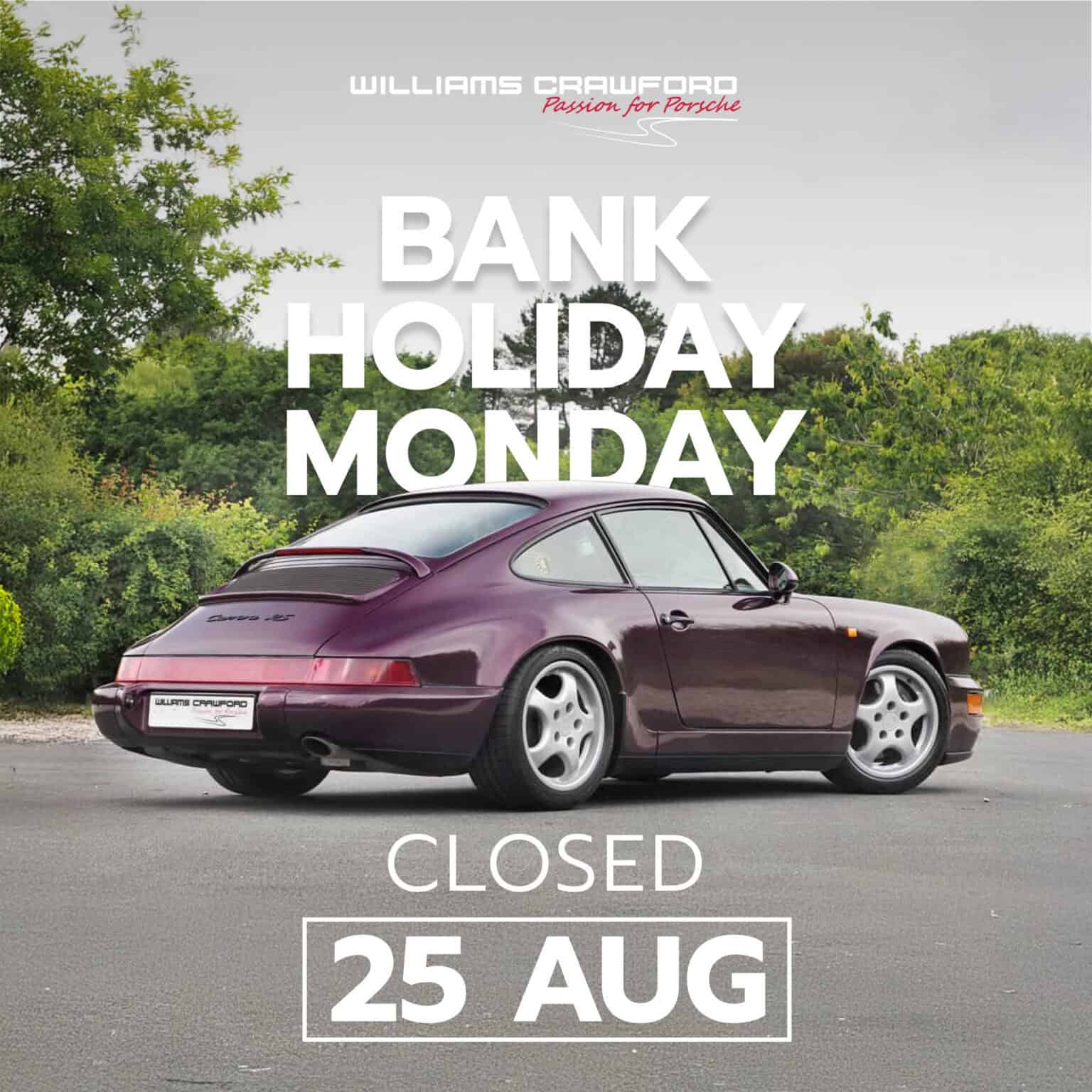
We’re open as usual this Saturday 9am-4pm, but will be closed for the Bank Holiday on Monday 25th August. If you would like to make an enquiry during this period, please email us and one of the team will come back to you as soon as we return.


This guide will help you in choosing a restoration partner, and applies if you are seeking a full restoration, bespoke build, major repairs, or major modifications.
Fill in your e-mail to receive our free guide.
